Saturday, 22 February 2014

Jane Bayliss

Some months ago while unexpectedly finding a free day on my hands on Aberdeenshire, I went for a run in the car to see what I could find. Fintray Parish Church I found not to be the most exciting looking in the world or even open that day but, had I not been stopped at the church's gate, it is unlikely that I would ever have noticed the sign hanging in the neighbouring drive. It was for the Jennifer-Jane Stained Glass Studio and, being open, I went in for a look. It is run by Jane Bayliss and her assistant Brian Innes, who very kindly let me take a few pictures, gave me a cup of tea and a generous slice of their day.

Most of the stained glass I see is in churches so it's nice to see a little domestic stained glass from time to time. The piece below is one of a number of small windows that were in the studio, some of which were still for sale when I was there.


Jane Bayliss had come to my attention before when I visited Crathie Kirk the previous year (mentioned briefly here) as she made one of the windows in the church.


A small window based on A Midsummer Night's Dream.


Landseer's Monarch of the Glen in Glass


Apart from windows she has made these fascinating bowls.


And this half egg shell which to my mind is quite gorgeous.


This large window was ready to be installed. Leaning against a table isn't the best way to see a stained glass window but the top is catching the sunlight and you can see the rest well enough to have a good idea how it will look in situ.


This window looks like it's still for sale too as it bears a price tag and the title Silver Darlings. Silver Darlings is the name of a novel by  Neil Gunn who was an author from the North East of Scotland. Silver Darlings refers to herring.


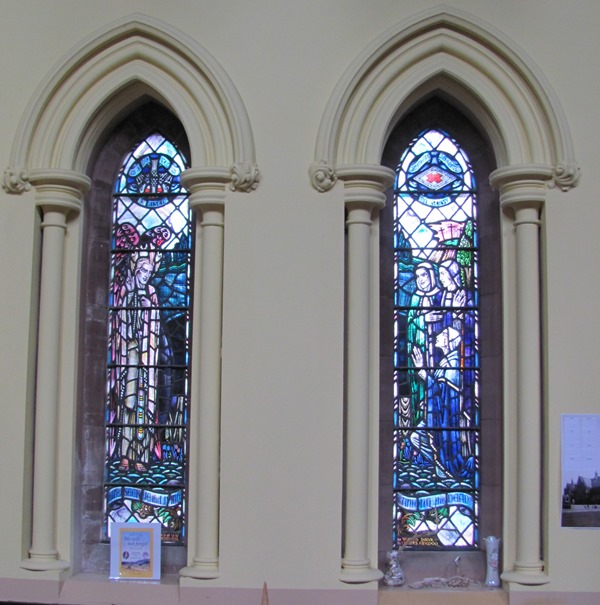
 These two windows are two of three that were made for the Migvie Chapel in Aberdeenshire in 2001. The symbols on the characters here are some of the mysterious Pictish Symbols which appear many ancient stones in the area and elsewhere in the North East. (my thanks to Caroline Parr and James Dyas Davidson who own the copyright for these photos and have given me permission to use them)


Tuesday, 22 October 2013

The Great West and East Windows of Holy Trinity, Coventry

On the night of 14th of December 1940 Conventry was bombed by the German air force. The ferocity of the bombing was well beyond what was expected and much of the centre of the city was destroyed, including most famously the cathedral. One church near the cathedral, which got of quite lightly that night, was The Holy Trinity. It didn't get away completely unscaved, it lost it's Great East and West windows. The current East and West windows date from the 1950s.

When I passed by a couple of months ago, there was a service on but you can see from the outside that there's something special about the Great West window, so I went away and had a cup of tea and something to eat and returned later. I was not wrong, the window is a cracker, it was designed by Hugh Easton and was dedicated in 1955.


This board tells you who all the personalities in the window are.


At the other end of the church, the Great East Window perhaps doesn't leap out at you in the same way that the West does. In a more traditional style, it is neither the less a superb window. I can't find an exact year of manufacture or dedication but it was sometime in the 1950s. It has come to be known as the Brides' Window since it was paid for with contributions from married couples in the 1940s and 1950s. It is by Ninian Comper. I fear I have not really done Sir Ninian's window much justice here, I only have a few decent pictures, but I have since seen some more windows by him and will make it up in a few blogs time.


You will notice that Sir Ninian and Hugh Easton both portray Christ as blond and beardless. Not what we normally see - was this requested by the church perhaps?


Tuesday, 27 August 2013

Gordon Webster at St Columba's in Largs

It's funny that after you see something once, it seems to be every where. Seems that windows by the stained glass artist Gordon Webster are like that. A few weeks ago I saw a number by him in Dunblane Cathedral, then I realised one of our local windows in Kirkcudbright was by him, followed by Ruthwell Parish church not all that far away. There are six windows in all, dating from between 1958 to 1968, and are characterised by his chiseled faces and blacked out eyes which I've now become quite accustomed to. 

When I went into St Columba's in Largs a month ago, he popped up again. Three windows by him, each in two panes. The interesting thing is that all three of these windows date to before the ones I've shown previously and none have blacked out eyes, though you can see his distinctive face shape appearing. They are shown here going back in time, the first is from 1955. I wonder if there's an exact cut off point somewhere between 1955 and 1978 where he stopped drawing in eyes.


This one is from 1952.


 Here's one which predates the last window by 21 years. His style is completely different here. At this point he had just been in charge his late father, Alf Webster's, stained glass business for two years and had perhaps not had a chance to develop the later style.


In the later windows he signs his name "Gordon Webster" and the date. Here he signs it "G MacW W" and the date. The middle W stands for MacWhirter


It seems a reasonable time to move away from St Columba's but staying with Mr Webster. You really don't expect to be able to buy stained glass windows of this quality for a reasonable sum, but I found this pair on Edinburgh auctioneers, Lyon and Turnbulls', website as having been sold for £2200. I couldn't work out quite when they were sold but it can't have been that long ago if they are still on the site. £2200 has to be cheap for two windows by a recognised maker. These were made around 1950.