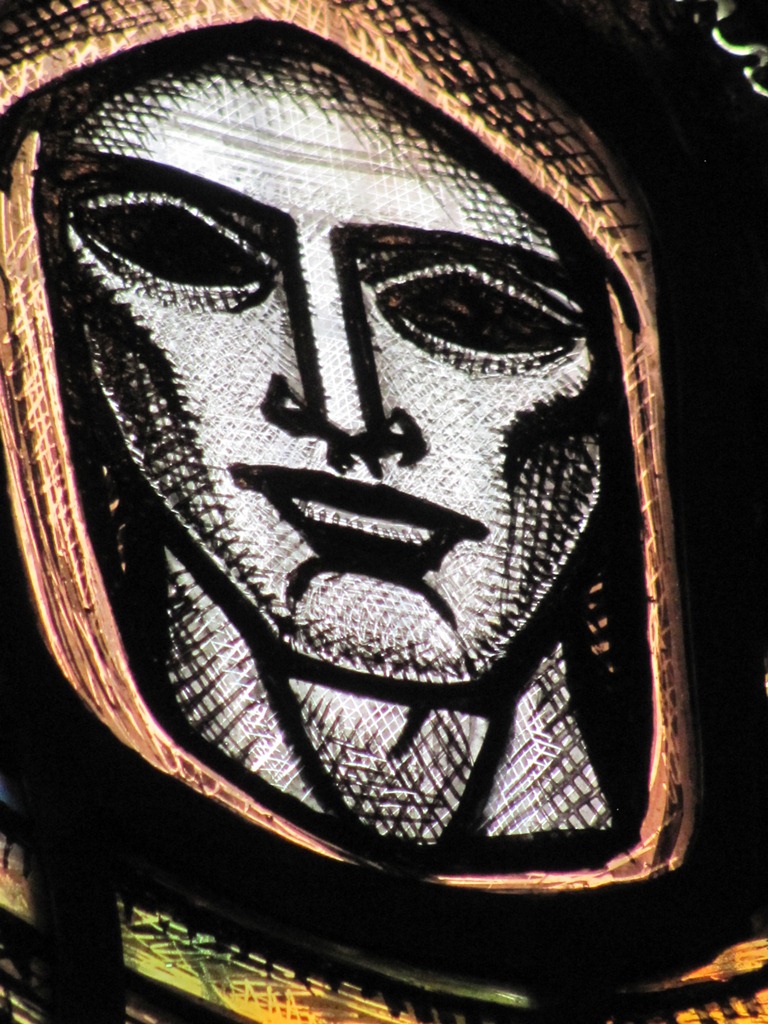
Only a short walk for me are these windows in Greyfriar's church in Kirkcudbright. This is the third church to stand on this point. There had been Franciscans (often known as Greyfriars because of their habit) established in the area of the town from the 12th century, though it seems nobody knows quite where, but in the late 15th century a Franciscan Convent was established and their church was on the site of the current church. It was taken over as the parish church in 1571 but by 1730 it was in a sorry state of repair and demolished except for a part reserved by the Maclennans as a burial aisle (their castle is just across the road). The new parish church was built onto the Maclennan aisle. This church only survived until 1839 when the current parish church was built elsewhere in the town and a school was built on the site, still retaining the Maclennan aisle from the original church. In 1919 the building became a church again, this time under the Scottish Episcopal Church. All the glass there today dates from after this.
Two of the windows in the church were designed by the late Isabella Findlay (died 2008) who was a member of the congregation. This one is dated 2004 (slightly obsured by the ledge but I'm fairly sure about it) and is marked "IF & SGDP 2004". I don't know who or what SGDP is. The lady who was looking after the church at the time remembers the window being put in.


This window is also by her, it's St Michael treading down the serpent. The church website says that this window is from 1961, I think this is a misprint as it quite clearly say 1951 on the window. It is also of note that the window is signed Isabella Douglas, which must have been Mrs Findlay's maiden name.


Above the altar, the early part of the church, is this window showing the Adoration of the Magi and dates from 1921. I have no information on the maker.


In the trancept is this window by Gordon Webster from 1961. it features St Cuthbert on the left, after whom the town is named and St Francis on the right, after whose order, the Franciscans or Greyfriars, the church is named.


Above St Cuthbert is the town coat of arms which features St Cuthbert in a boat holding St Oswalds head.

This is the coat of arms of the Episcopal Diocese of Glasgow and Galloway


This part of the window shows Maclellan's Castle, which stands at the centre of the town (and the end of the street I live in) and to the right the Tolbooth - another building of note in the town (also in my street)

This is the Basilica at Assisi, which is connected to St Francis.