Showing posts with label Stirling and Falkirk. Show all posts

Saturday, 17 August 2013

St Mary's in Dunblane

On the way to the cathedral in Dunblane I passed St Mary's Episcopal church. It was unlocked, which is all I need to tempt me in for a look at their windows. I'll start off with these two from the 1940s.


I could find very little information on the windows in this church except that it had stained glass by James Hogan who worked for James Powell and Sons of London. A little further investigation showed that the company's signature was a cowled monk, which appears on both the windows above. Here it is enlarged from the second one.

Above the altar was this patterned window.


At the other end of the church was another patterned window, except that this time is was just glazed in plain glass. Perhaps it had once been coloured and refilled with plain glass due to damage or it had started out this way. Quite striking in it's own way.


A much more recent window.


Also with a signature but this time with no clue for finding out who it's by. [Since writing this blog, I have been sent some information for which I am very grateful. This was made by Aurora Glass in Alloa, which was the studio owned by Emma Shipton, who I assume made this window. The words in the window, "Know thou, o stranger to the fame, of this much lov'd, much honour'd name!" are words from Burns (though sharing a surname, there is some added significance since when Sir John was a prisoner of war he carried a volume of Robert Burns in his pocket). Burns originally wrote the lines to Robert Aitken and here they subtly display only half the verse, the whole of which is more obviously an epitaph.

Know thou, O stranger to the fame
Of this much lov'd, much honour'd name!
(For none that knew him need be told)
A warmer heart death ne'er made cold.]


I nearly missed this window, just beyond the door in the side of the church. I spotted it from the outside while leaving and went inside to see what I had missed. It features a couple of lines from Psalm 126 and a delightful painted poppy in amongst some wheat.


Sunday, 21 July 2013

Gordon Webster at Dunblane Cathedral

As you walk in the door at Dunblane Cathedral, this window is opposite you. It's one of the later windows in the Cathedral, dating to 1968 and made by Gordon Webster. There isn't much information about Gordon Webster. He lived from 1908 till 1987 and his father, Alf Webster, made stained glass windows too. Alf died in 1915 and Gordon's mother looked after the firm until Gordon took over in 1929. Slightly confusingly the information I have also says that Douglas Hamilton looked after the firm in those years and he trained Gordon in stained glass.


They're lovely windows but I'm not sure about the thing with the blacked out eyes. I noticed that the Abbey Studio windows in the Fairmilehead church, two blogs ago, went in for the same thing. It's a little creepy.


There are another three windows by him in the chapter house. These are a little earlier at 1959, 1963 and 1966 (probably - I couldn't see the date very well because of the lip of the stone)


Friday, 12 July 2013

Douglas Strachan at Dunblane Cathedral

You may remember in my main blog a few week ago there was a spectacular window by Douglas Strachan in St.Giles Cathedral. There are another four in Dunblane Cathedral (one of which I showed here). They are more modest in both size and extravagance of execution. Though with less "Cor Blimey" factor about them, the strength of character in his figures is certainly no less.

The first two window here are in the chapter house. This window shows figures of local and Scottish significance. In the centre below Christ is St. Andrew.


Behind this First World War soldier is Bishop Maurice, who was Bishop of Dunblane in 1319 and 1322 to 1347. He was, more famously, chaplain to the Scottish army in 1314 and blessed the troops before Bannockburn.


St Blaan is an alternative spelling of St Blane after whom the town is named.


This window appears to be a straight forward scene from the Bible. It is, of course, the last supper. The other window of his in the chapter house (see my Witterings blog) similarly features a bible scene, Jesus healing the sick, without any further significance that I can see or that has been brought to my attention.


This larger window is to be found in the nave of the church. It features The baptism of Jesus by John the Baptist. This window was designed in 1926. I have no information about the dates of the chapter house windows, but considering the military theme of one and the fact the war memorials are in there, it might be reasonable to guess that they were made much closer to the end of the First War.


Tuesday, 9 July 2013

Louis Davis at Dunblane Cathedral

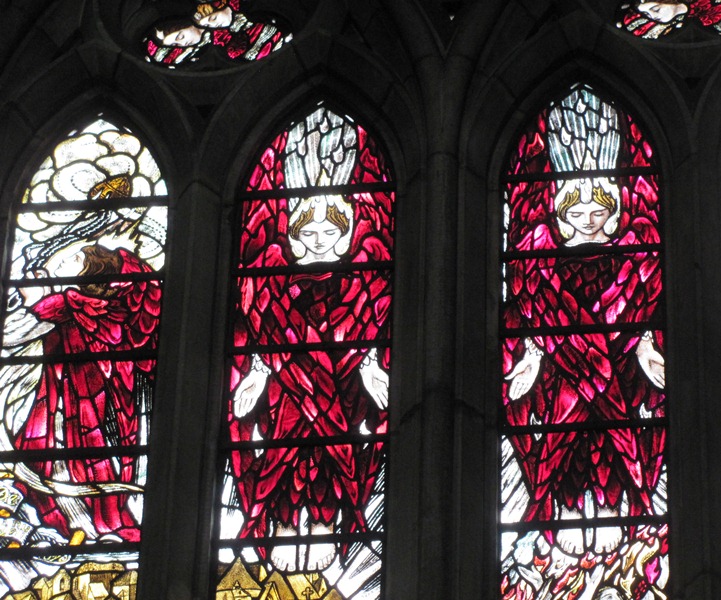
Situated on the South wall of the choir at Dunblane Cathedral are six windows by Louis Davis . I'd never heard of him before but if this is anything to go on then I certainly hope to come across him again. There are other windows by him in the cathedral which will likely appear here another time and some across at Witterings when I do the blog for the building.

It was donated by Sir Robert Younger in 1915 (if you read the guidebook) or 1913 (if you prefer Wikipedia) but both seem to agree that it's based on a piece of religious text called Benedicite Omnia Opera. 

The outside windows of the six feature the four Archangels between them, Michael, Gabriel, Uriel and Raphael


The first window we see below is called the Allegory window and represents the features of the heavens, Sun, Moon, stars and clouds as well as the four winds.


The second window (some of which has disappeared behind the choir stall (grumble) like the Allegory window) is called the Chaos Window. It shows fire, storms, cold and snow.


Just below the rather chilly young lady above are the names of Captain Scott and the other four members of the party who died on the ill fated expedition to the South Pole in 1912. This is remembered now so must have been very fresh in the memory when the window was made.


This is the Earth Window, with representations of animals, fish and plants and also Noahs ark.


This is the Humanity Window, which has Adam and Eve in the bottom right hand corner with David and Jacob above them. To the left the blessed make their way to heavenly Jerusalem, included in their number are St Margaret of Scotland, William Blake and St Blane (who gives his name to the town).

Here's a slight zoom in of the bit with Queen Margaret, St Blane and I think that's William Blake just under them holding the book