Showing posts with label Gordon Webster. Show all posts

Tuesday, 27 August 2013

Gordon Webster at St Columba's in Largs

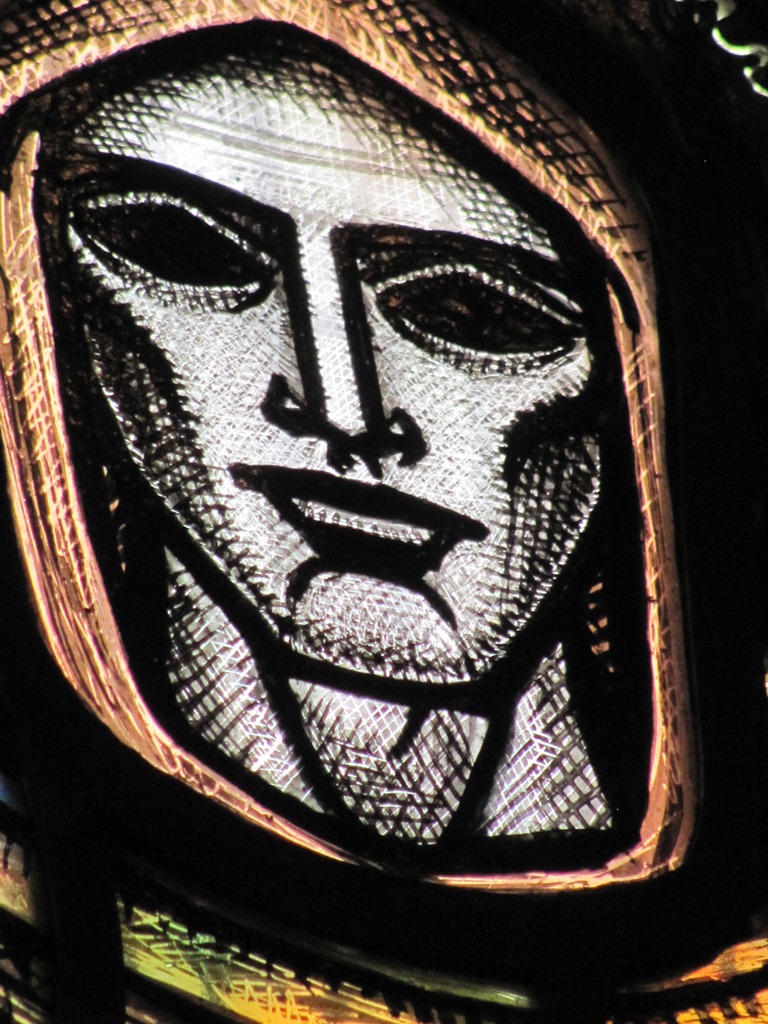
It's funny that after you see something once, it seems to be every where. Seems that windows by the stained glass artist Gordon Webster are like that. A few weeks ago I saw a number by him in Dunblane Cathedral, then I realised one of our local windows in Kirkcudbright was by him, followed by Ruthwell Parish church not all that far away. There are six windows in all, dating from between 1958 to 1968, and are characterised by his chiseled faces and blacked out eyes which I've now become quite accustomed to. 

When I went into St Columba's in Largs a month ago, he popped up again. Three windows by him, each in two panes. The interesting thing is that all three of these windows date to before the ones I've shown previously and none have blacked out eyes, though you can see his distinctive face shape appearing. They are shown here going back in time, the first is from 1955. I wonder if there's an exact cut off point somewhere between 1955 and 1978 where he stopped drawing in eyes.
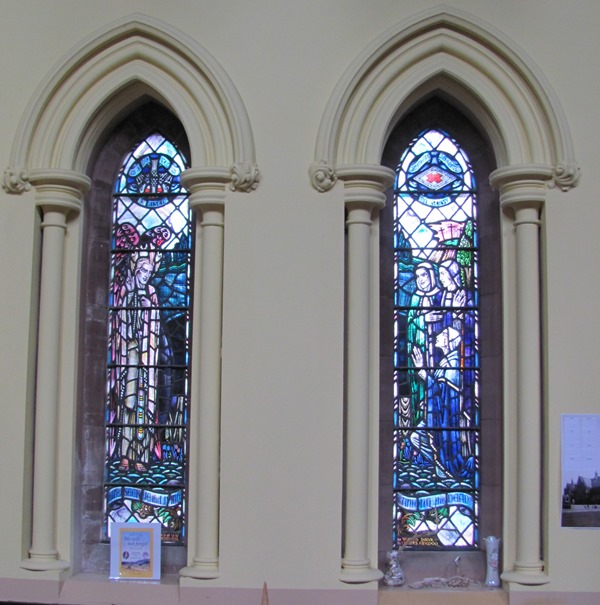


This one is from 1952.


 Here's one which predates the last window by 21 years. His style is completely different here. At this point he had just been in charge his late father, Alf Webster's, stained glass business for two years and had perhaps not had a chance to develop the later style.


In the later windows he signs his name "Gordon Webster" and the date. Here he signs it "G MacW W" and the date. The middle W stands for MacWhirter


It seems a reasonable time to move away from St Columba's but staying with Mr Webster. You really don't expect to be able to buy stained glass windows of this quality for a reasonable sum, but I found this pair on Edinburgh auctioneers, Lyon and Turnbulls', website as having been sold for £2200. I couldn't work out quite when they were sold but it can't have been that long ago if they are still on the site. £2200 has to be cheap for two windows by a recognised maker. These were made around 1950.


Wednesday, 14 August 2013

Greyfriar's in Kirkcudbright

Only a short walk for me are these windows in Greyfriar's church in Kirkcudbright. This is the third church to stand on this point. There had been Franciscans (often known as Greyfriars because of their habit) established in the area of the town from the 12th century, though it seems nobody knows quite where, but in the late 15th century a Franciscan Convent was established and their church was on the site of the current church. It was taken over as the parish church in 1571 but by 1730 it was in a sorry state of repair and demolished except for a part reserved by the Maclennans as a burial aisle (their castle is just across the road). The new parish church was built onto the Maclennan aisle. This church only survived until 1839 when the current parish church was built elsewhere in the town and a school was built on the site, still retaining the Maclennan aisle from the original church. In 1919 the building became a church again, this time under the Scottish Episcopal Church. All the glass there today dates from after this.

Two of the windows in the church were designed by the late Isabella Findlay (died 2008) who was a member of the congregation. This one is dated 2004 (slightly obsured by the ledge but I'm fairly sure about it) and is marked "IF & SGDP 2004". I don't know who or what SGDP is. The lady who was looking after the church at the time remembers the window being put in.


This window is also by her, it's St Michael treading down the serpent. The church website says that this window is from 1961, I think this is a misprint as it quite clearly say 1951 on the window. It is also of note that the window is signed Isabella Douglas, which must have been Mrs Findlay's maiden name.


Above the altar, the early part of the church, is this window showing the Adoration of the Magi and dates from 1921. I have no information on the maker.


In the trancept is this window by Gordon Webster from 1961. it features St Cuthbert on the left, after whom the town is named and St Francis on the right, after whose order, the Franciscans or Greyfriars, the church is named. 


Above St Cuthbert is the town coat of arms which features St Cuthbert in a boat holding St Oswalds head.

This is the coat of arms of the Episcopal Diocese of Glasgow and Galloway


This part of the window shows Maclellan's Castle, which stands at the centre of the town (and the end of the street I live in) and to the right the Tolbooth - another building of note in the town (also in my street)

This is the Basilica at Assisi, which is connected to St Francis.


Wednesday, 31 July 2013

Ruthwell Parish Church

In the apse built to take the cross at Ruthwell church there are three windows which each contain a saint local to the Northumbrian region made by Percy Bacon Brothers in London, This one is St Hilda.


In 657 Hilda became the founding  Abbess at Whitby Abbey. Here you can see her holding a model of the abbey, as is often seen in pictures of founding and patron saints of churches. As far as I can see, such representations usually appear in the church that is pictured, but in this case, Whitby Abbey has been in ruin for hundreds of years. By comparing the windows in the model with this picture of the ruins, you can see it is the same building. It is of some interest that it was Whitby Abbey's ruins that inspired Bram Stoker to write Dracula.


Another appearance by St Cuthbert, briefly Bishop of Lindisfarne.


The third window is of St Aiden, who was one of St Cuthbert's predecessors and said to have inspired him. St Aiden was the first Bishop of Lindisfarne. It is interesting to note that for a brief period in the 7th century all three of these people in the windows would have been alive at the same time.


These windows seem a little bit long for the frames and the glass continues behind the frame a little. Perhaps this is not uncommon and I only saw it because I could get particularly close to the windows.

The St Aiden window is dedicated to the Reverend James McFarlan (St Cuthbert to his wife and no name is mentioned on St Hilda). It was he that was minister of the church in 1887 when the Apse was built and cross brought inside. Residents of nearby Clarencefield may also recognise the name as the local village hall bears it.


There is a window made by Gordon Webster  in 1958 - he was mentioned a few blogs ago for his windows in Dunblane cathedral and I have seen his windows in other places to which will appear here in due course.


The plainer windows in the church are all edged in orange and  yellow - most appealing.


Sunday, 21 July 2013

Gordon Webster at Dunblane Cathedral

As you walk in the door at Dunblane Cathedral, this window is opposite you. It's one of the later windows in the Cathedral, dating to 1968 and made by Gordon Webster. There isn't much information about Gordon Webster. He lived from 1908 till 1987 and his father, Alf Webster, made stained glass windows too. Alf died in 1915 and Gordon's mother looked after the firm until Gordon took over in 1929. Slightly confusingly the information I have also says that Douglas Hamilton looked after the firm in those years and he trained Gordon in stained glass.


They're lovely windows but I'm not sure about the thing with the blacked out eyes. I noticed that the Abbey Studio windows in the Fairmilehead church, two blogs ago, went in for the same thing. It's a little creepy.


There are another three windows by him in the chapter house. These are a little earlier at 1959, 1963 and 1966 (probably - I couldn't see the date very well because of the lip of the stone)